
Birding my Backyard
Turning obstacles into opportunities

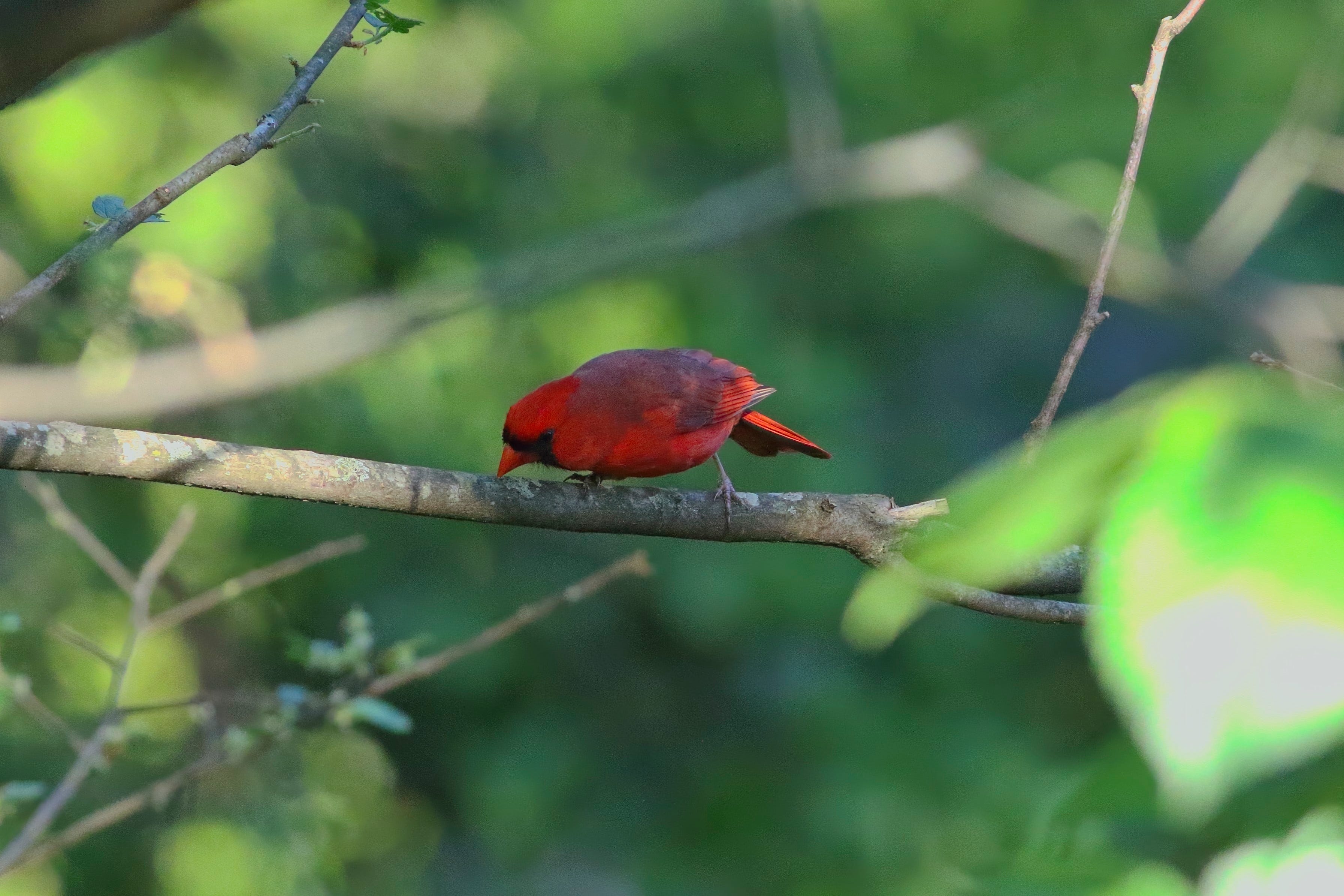
Welcome to the Birds and Mammals edition of springtime in my garden!
My unlucky April taught some valuable lessons — not only to be careful around poison ivy or how to take care of a sprained ankle, but also how to be still and notice the wild world in an urban environment even more than I did before.
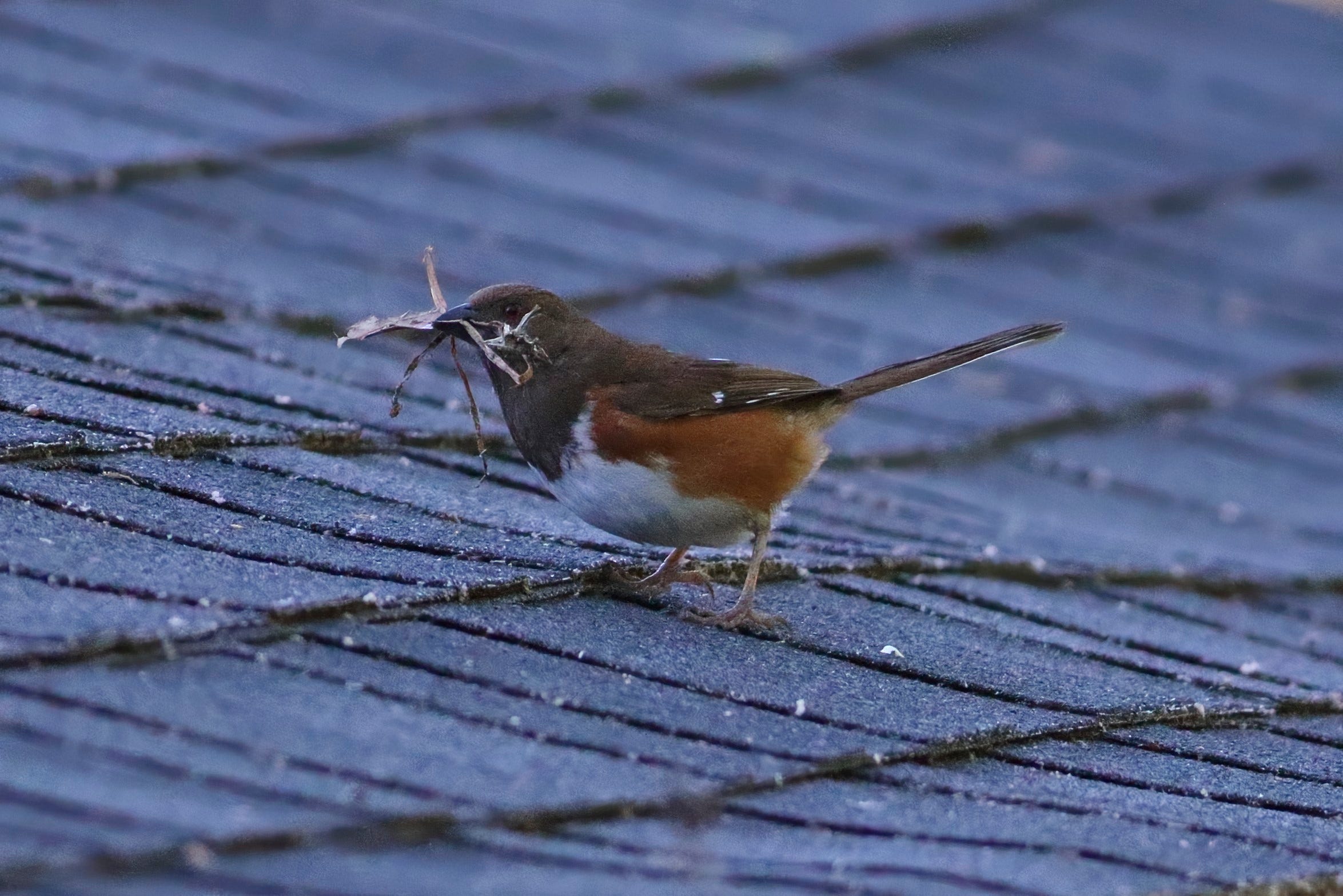
I give a talk on “noticing nature everywhere,” stressing that one can find beauty, wildlife, and wonder even in cities, but I was still disappointed to spend the first peak week of spring warbler migration home and resting. That weekend, even my yard, with its stairs, slopes, rocks, and roots, was treacherous. I managed one very slow walk with walking stick, camera, and macro lens. The result was enough photos for two weeks of Falling in a Bog content!1 This was a lesson indeed.
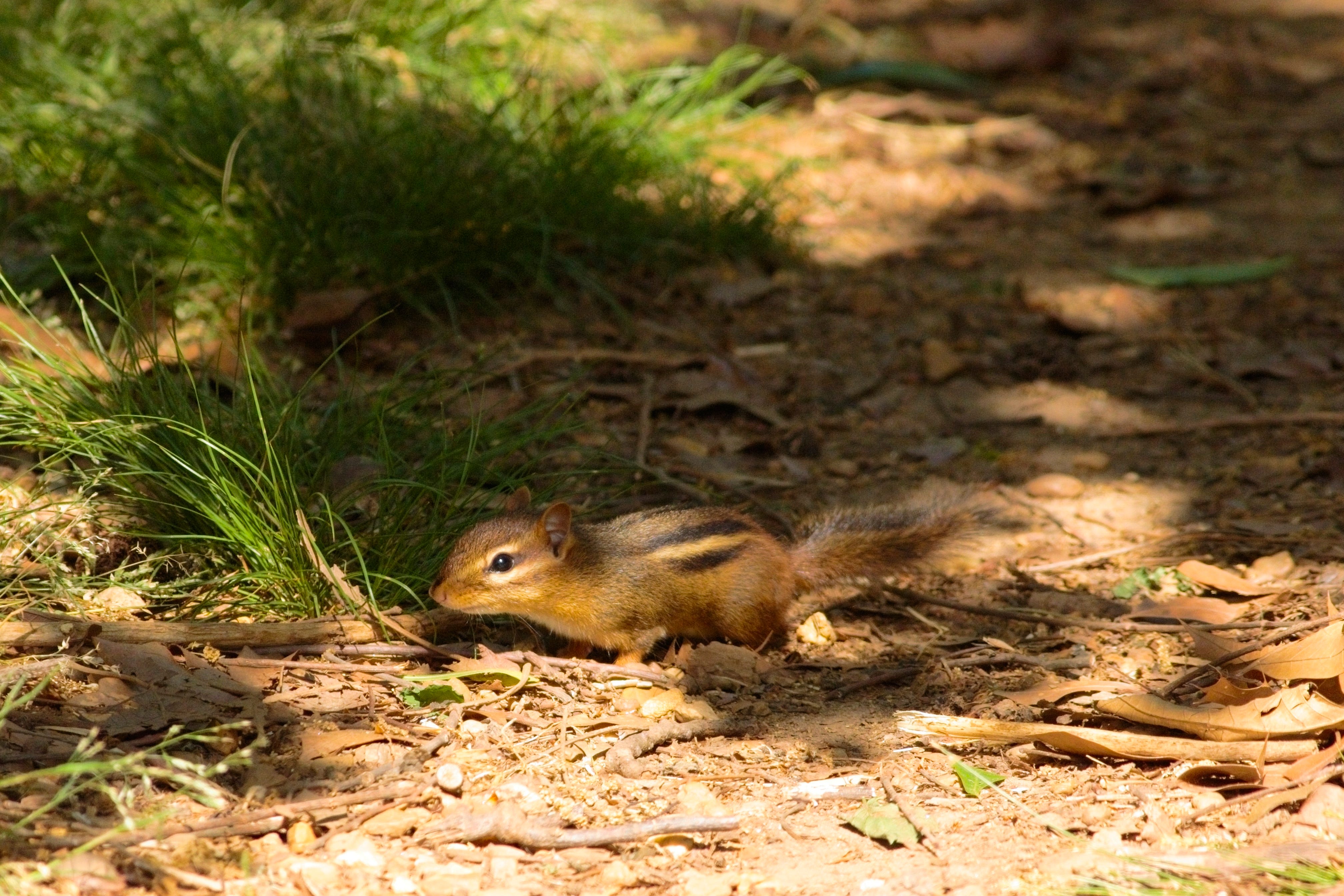
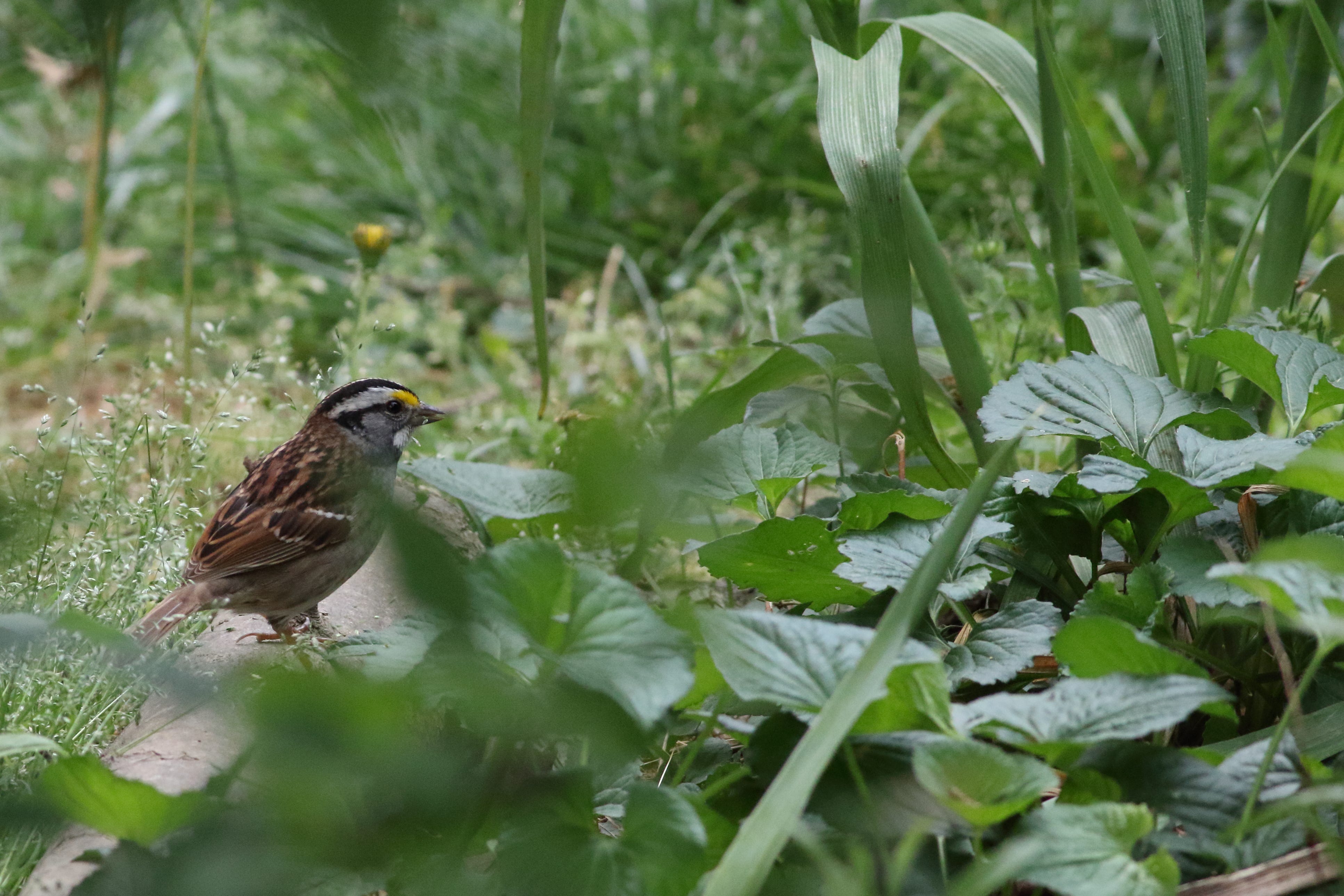
When forced to rest and be still, I spent as much time as I could on the back porch with my birding camera and 400mm lens. Instead of complaining, I challenged myself to work with what I had — the backyard wildlife, the porch balusters and other manmade objects “in the way,” and the very leafy and shady foliage over my backyard, which both obscured and shaded the birds I wanted to photograph. I decided to try incorporating these things into the photos. Today I share some of the results with you.
Also, thank you to all those who sent their well wishes last week. I’m much better — no poison ivy, no respiratory virus, and my leg is almost completely better. I still have to be careful on stairs and rocky or root-y terrain, but I can go hiking again. I am working on processing the photos from May’s adventures for future posts. Keep an eye on Notes, too!
One more piece of admin — after being asked many times over the years if I sell prints, I finally set up a shop. If you want a print of something that is not listed, let me know, and I’ll put it in the shop. I am also setting up a Buy Me a Coffee shop with print-ready digital downloads of favorite photos. Paid subscribers will get a code for a free download. I’ve wanted to offer something to paid subscribers without putting any Falling in a Bog content behind a paywall, but I was not sure what I could offer that 1) people might actually want, 2) would not involve a time commitment I could not meet, like extra posts, and 3) would not end in me losing money (like free prints. I’d love to offer free prints, but I’m not there yet.) If you have ideas for other things I can provide to paid subscribers, I am open to ideas!
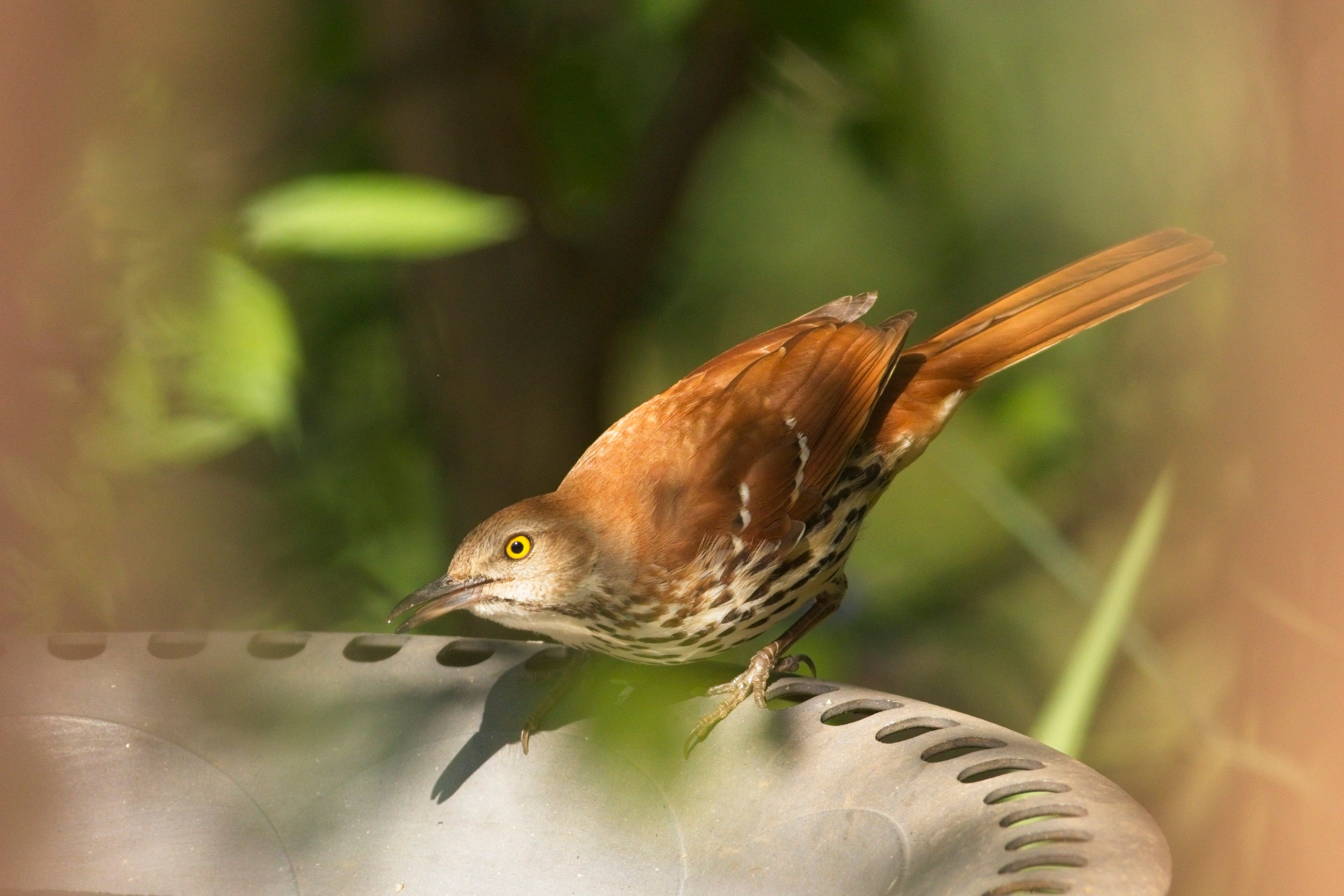
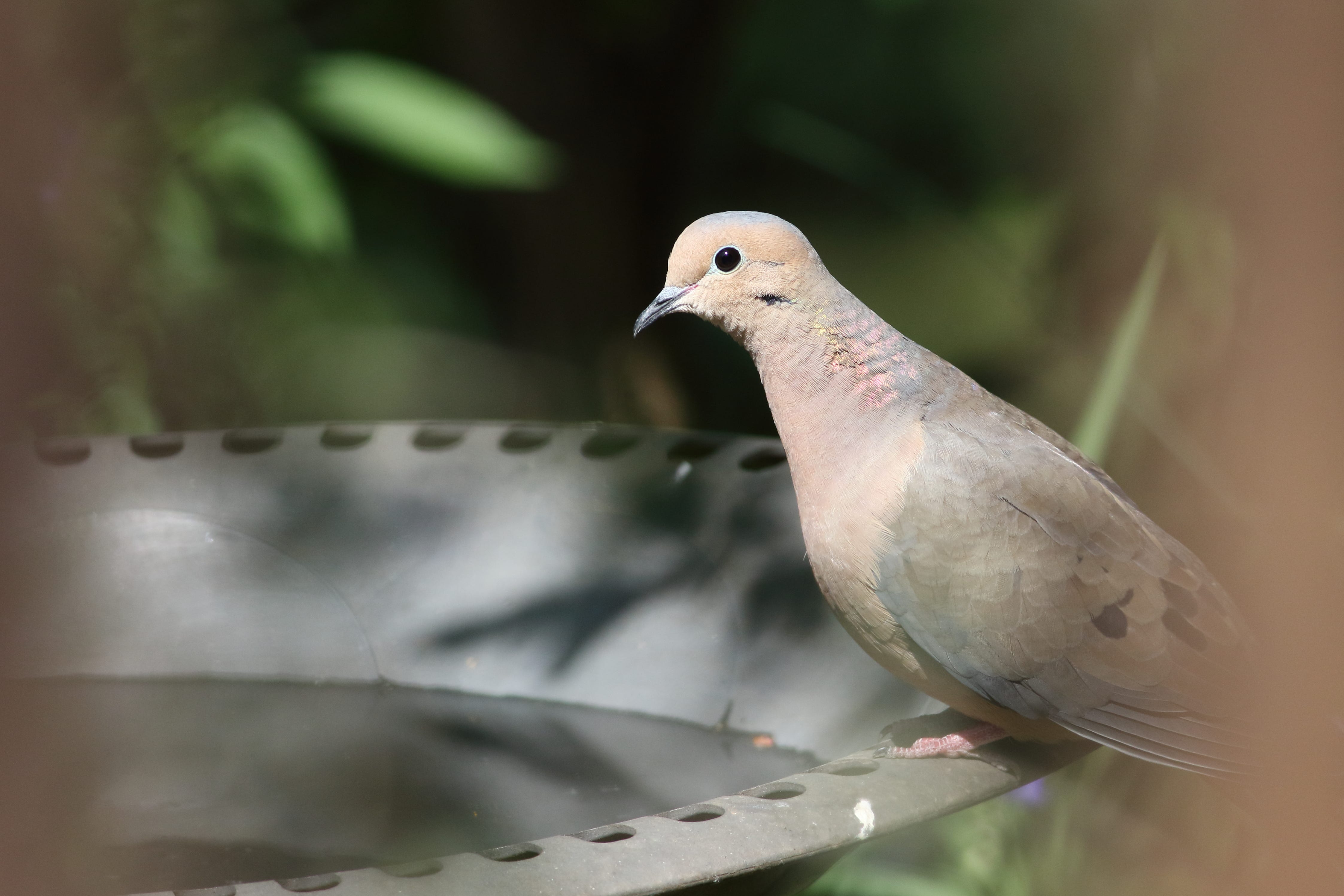
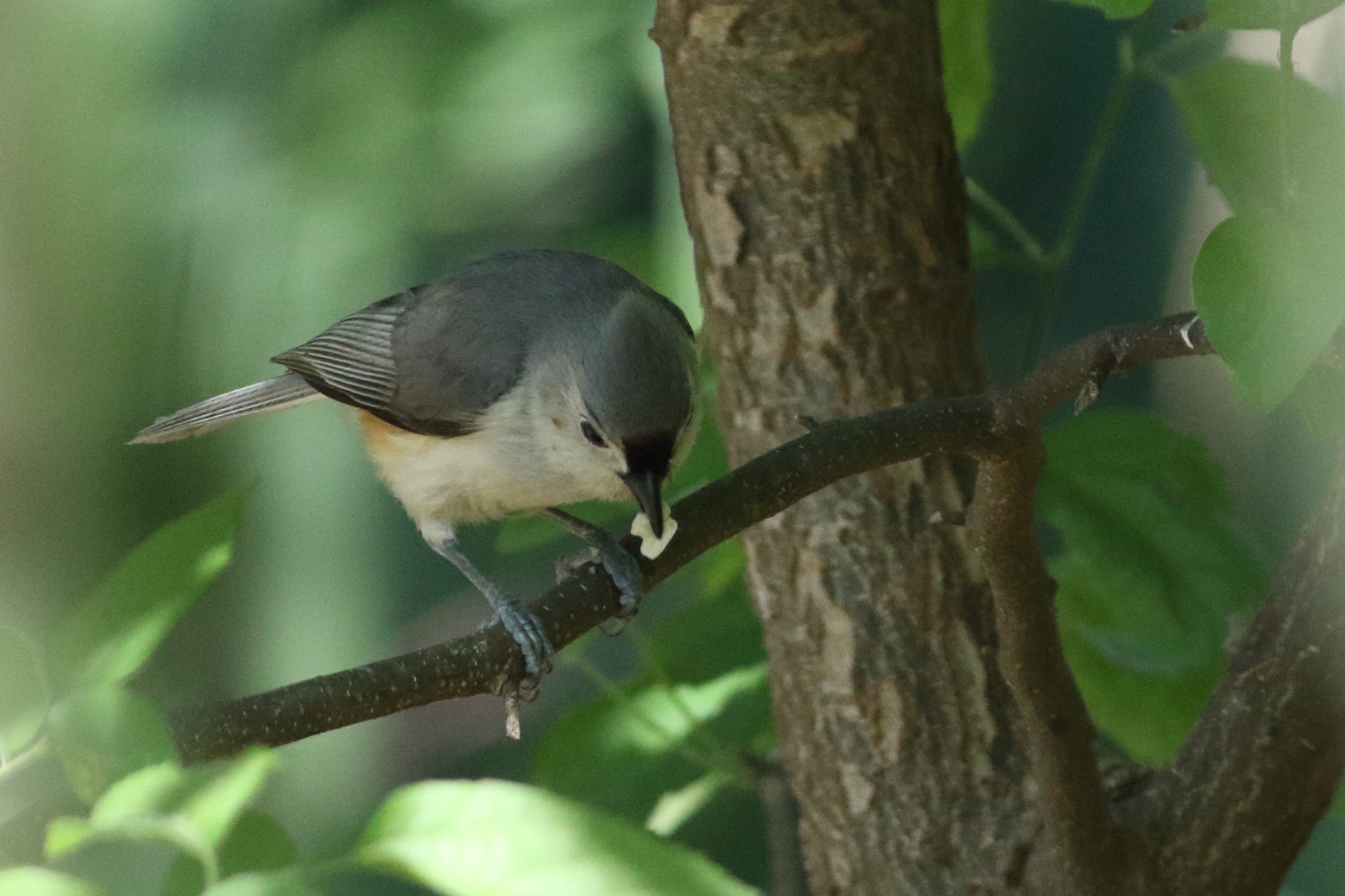
The photos below were taken from my back porch through the balusters, attempting to incorporate them as a soft focus brown frame, instead of a distraction. I’d love to hear what you think! Would you like to see more like this?
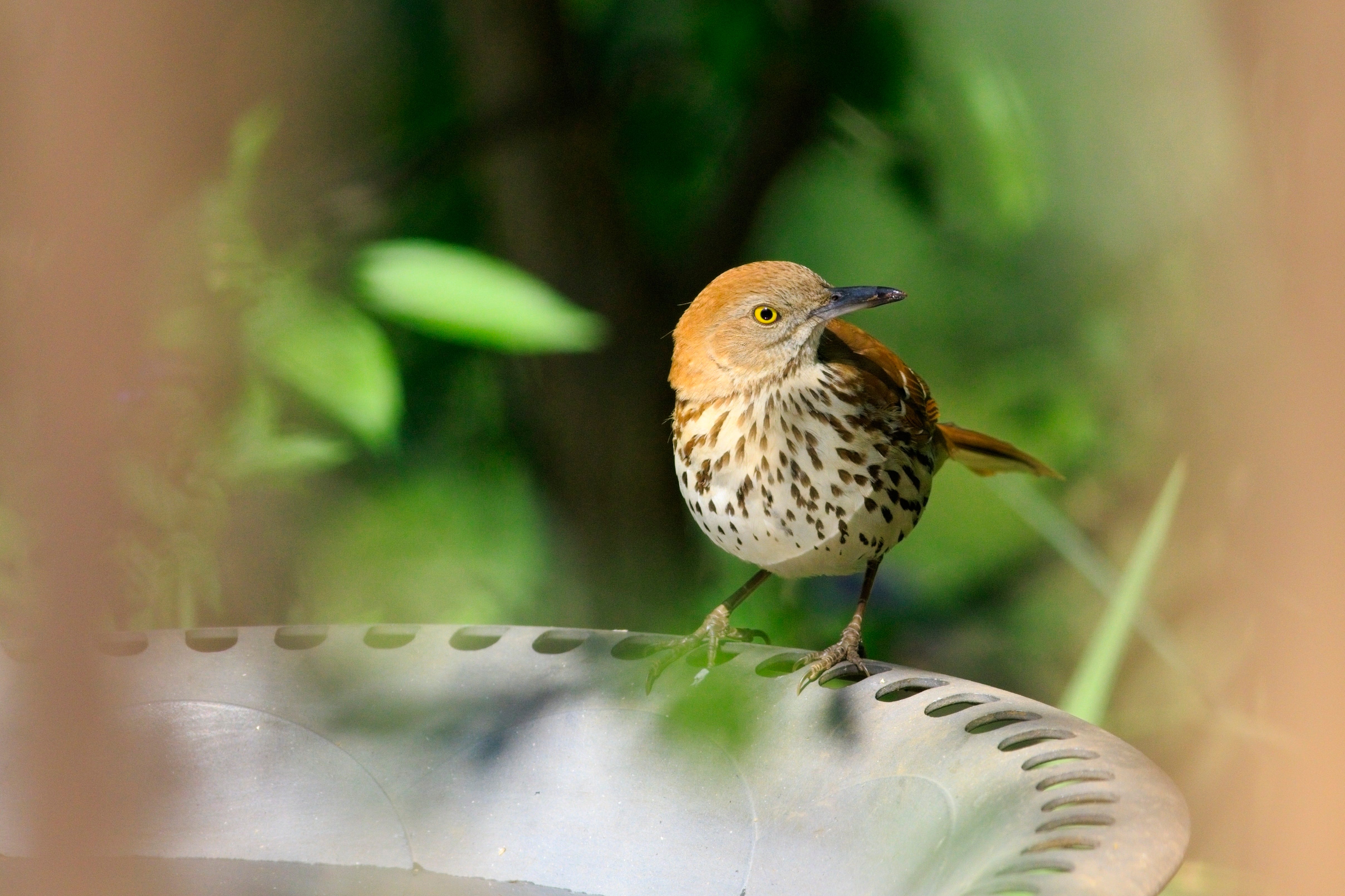
Our state bird, the brown thrasher, is shy. Rarely will they let me get this close, even the pair that live in my yard and are used to me. But from the porch, I could watch this one at the bird bath for quite some time, though I believe (as in the photo below) those bright yellow eyes did not miss my presence one bit.
What the below photo of a mourning dove taught me was that, as if these birds weren’t beautiful enough with their graceful form and pale blue eye ring, they apparently have a patch of iridescent pink on at least one side of their necks! I’d never noticed that before.
Below, the porch post frame blends in with other soft focus stuff around this tufted titmouse capturing a caterpillar.
From my porch, I documented the birds not only by sight but sound. It started around April 20th, hearing both wood thrushes (who migrate to Atlanta in spring) and white-throated sparrows (who winter in Atlanta and leave in spring) in the morning chorus. Had I ever heard these two duet before? It seemed late for white-throated sparrows in Atlanta.
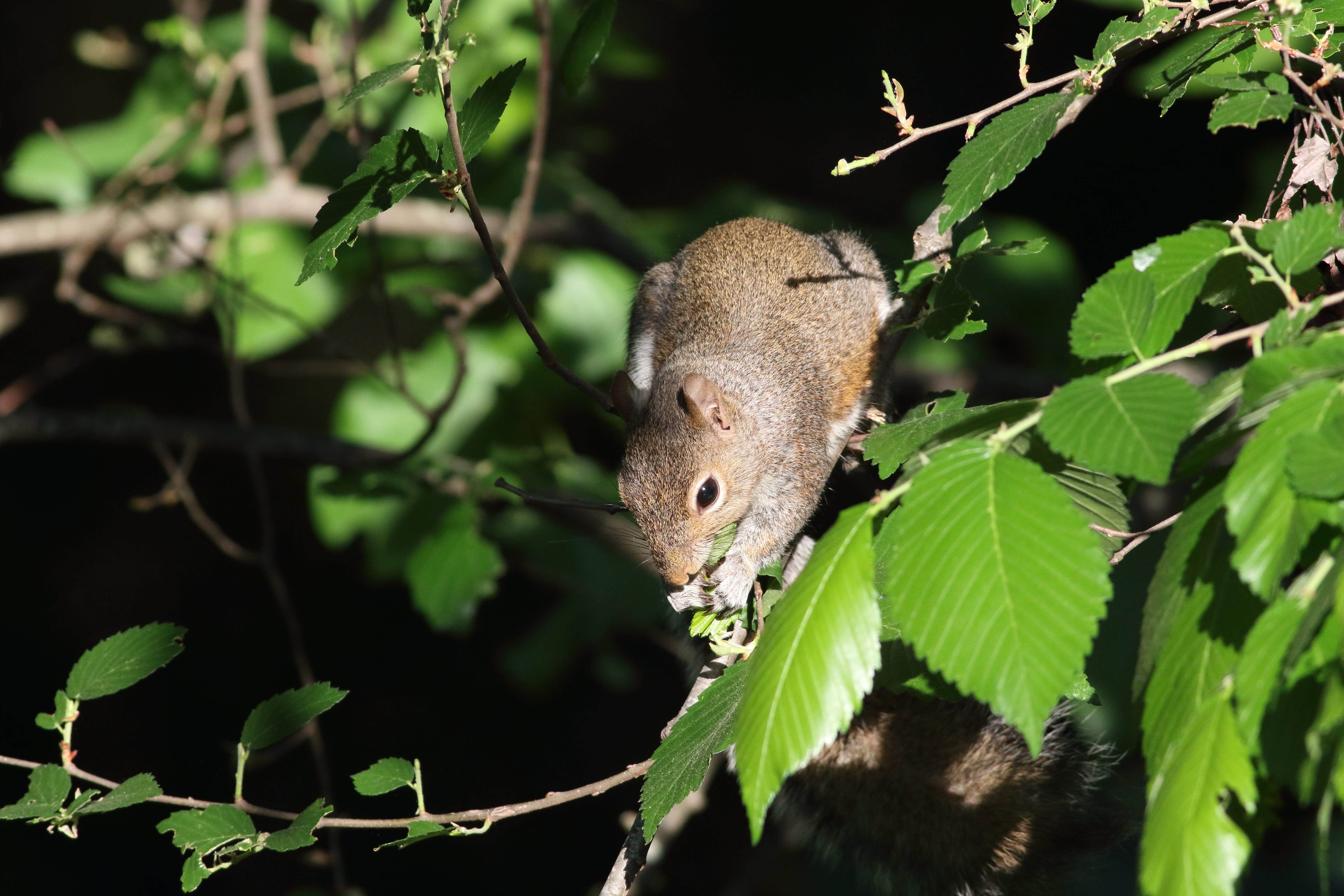
It seemed like this chance may not come again, to record the otherworldly fluting of a wood thrush and the high, melodic whistle in response of a white-throated sparrow. But city noise kept interfering with my attempts. A car stereo blaring past, a truck clanking and rumbling down the road, my dogs’ collars jangling, my dogs barking at a squirrel, and then, from the nearby airport, a plane would sweep its cotton-cloud blanket of white noise across all of it.
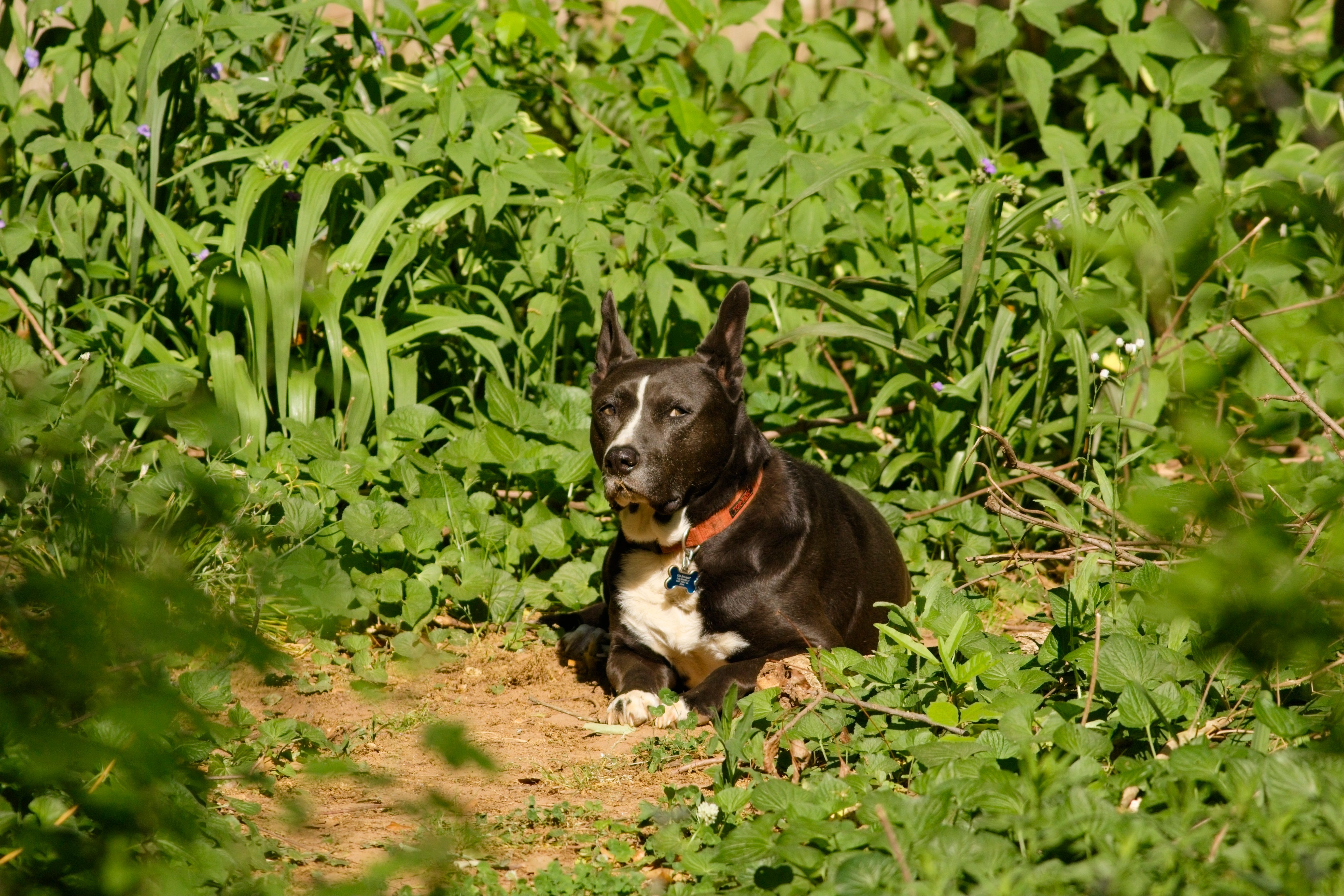
The next morning, I tried again. Both wood thrush and white-throated sparrow were present and singing. But just as I hit “record,” the first backyard great crested flycatchers of the year announced their arrival. Though I love their wheeps, whoops, and even their shrieks, I sometimes think of them as “great crested screamers.” That morning, they were vocalizing in a way that sounds, to me, like a cross between a bird call, a croaking frog, and a scream.
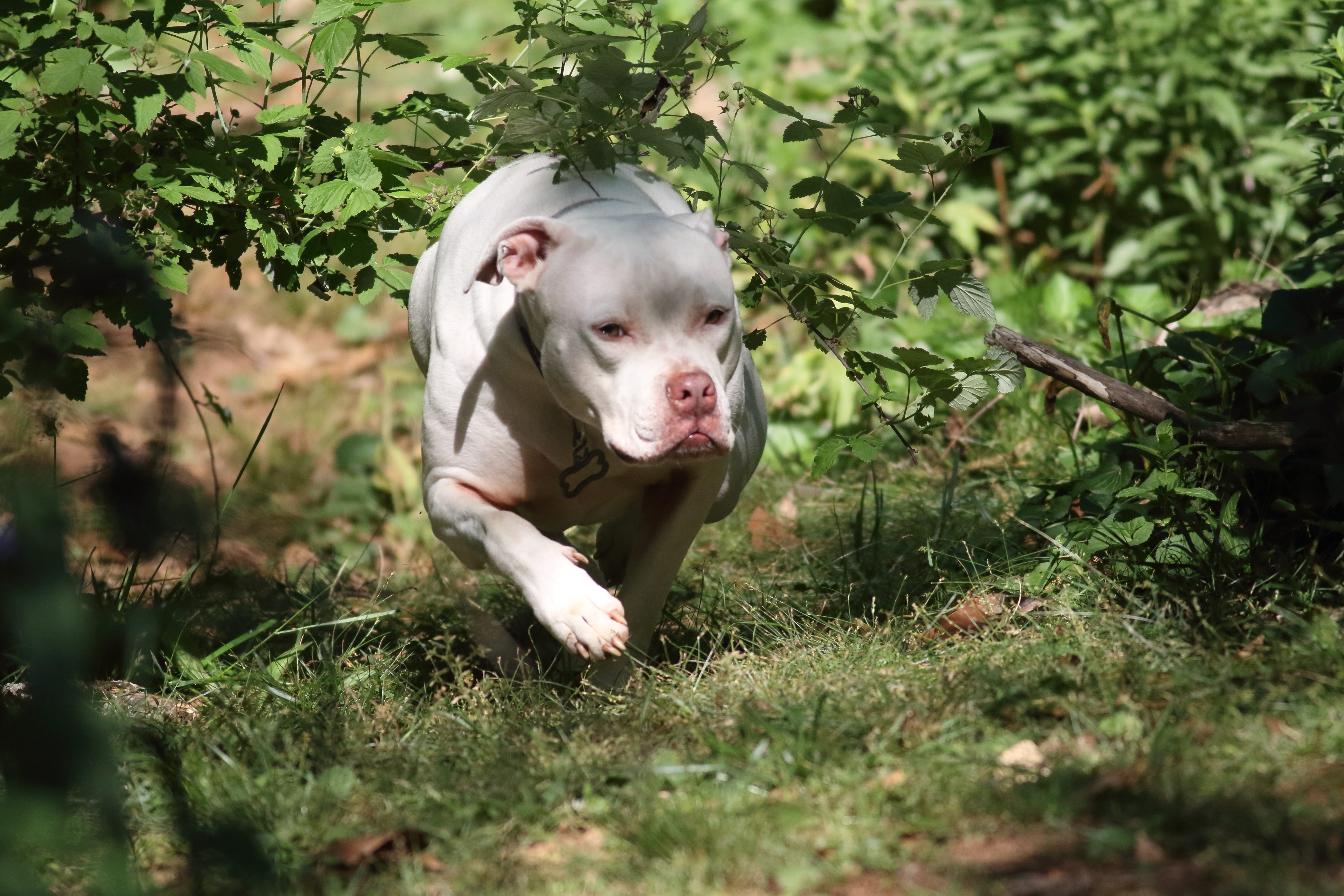
Instead of “flute, whistle, flute,” I had “flute—SHRIEK! SHRIEK! SHRIEK!”, then the bell-like chime of a Carolina wren, but a very loud and close Carolina wren — and just as a distant white-throated sparrow began to sing, an airplane flew overhead, dropping its cozy soft sound blanket down to smother all birdsong. Have a listen, if you’d like:
Later in the week, I heard something unusual and beautiful, like the song of a warbler but in a thrush’s voice, followed by the ethereal song of a veery. It was a Swainson’s thrush!
It was also trash day. I tried practicing radical acceptance with my backyard soundscape. Like the porch rails framing bird photos, the clunk of the garbage truck was just part of the song. Thus I present to you Swainson’s Thrush and Airplane, with Garbage Truck a Block Away as distant percussion, and a descant by Northern Mockingbird Pretending to be a Killdeer.
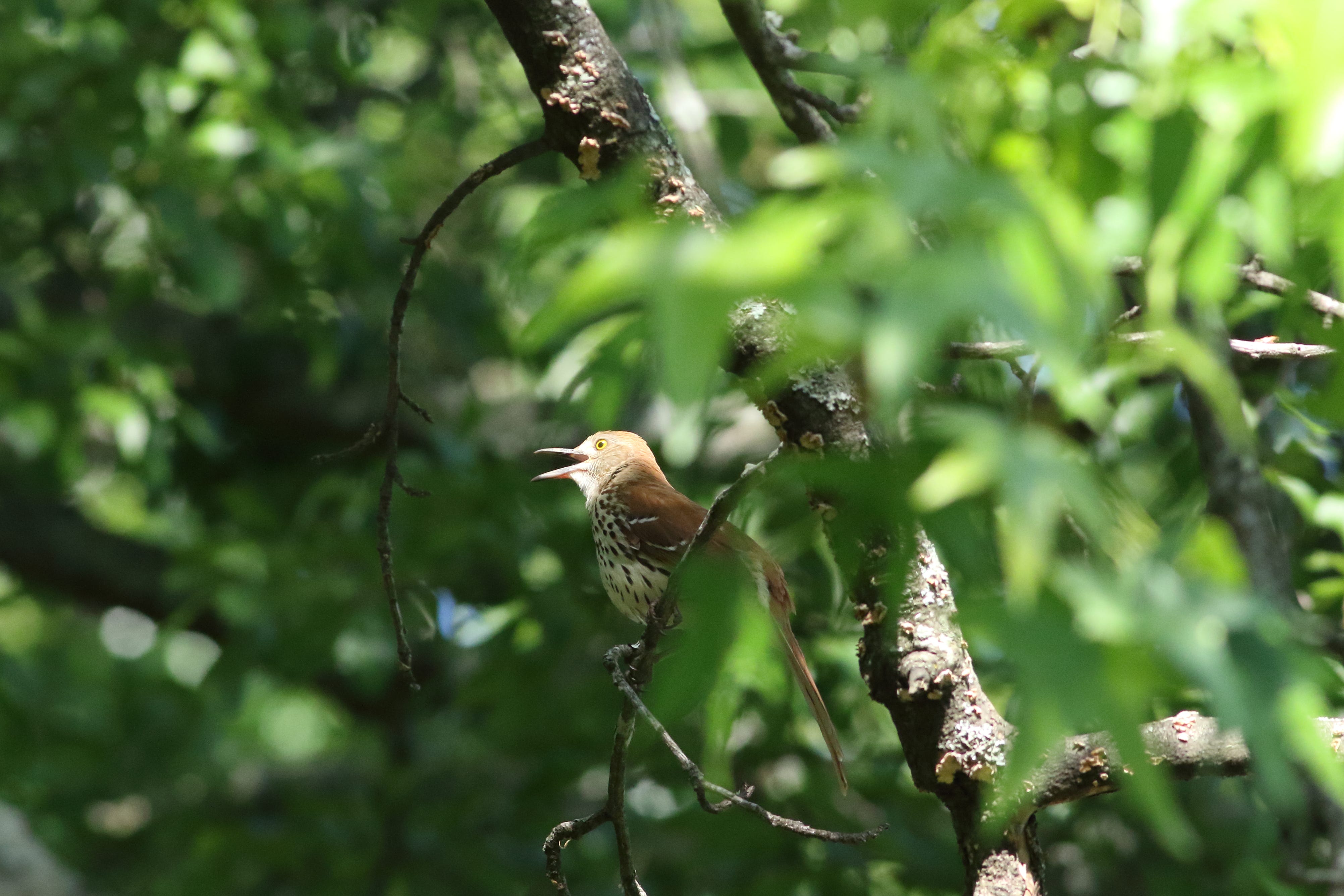
I also recorded a brown thrasher, one of the first birds I learned to identify by sound in spring 2020. Mockingbirds repeat a phrase three or more times in a song, but brown thrashers repeat a phrase exactly twice. I have only heard them do this in spring. The rest of the year, all I hear from them is rustling in the leaves and sometimes a harsh, “TCH!” In spring, this usually shy bird becomes bold, belting paired tunes from high in the trees.
By last Monday, I had recovered enough for reasonable hikes! I began to scheme how I could fit in a weekday trip to Murphey Candler Park with my work schedule. But when I went into the garden to let the dogs out before breakfast, I heard a blackpoll warbler and a yellow warbler — two garden firsts! Later, an orchard oriole arrived, the third new yardbird species in just one day.
There was really no point in driving to the opposite end of the city when I could see plenty of good birds here.
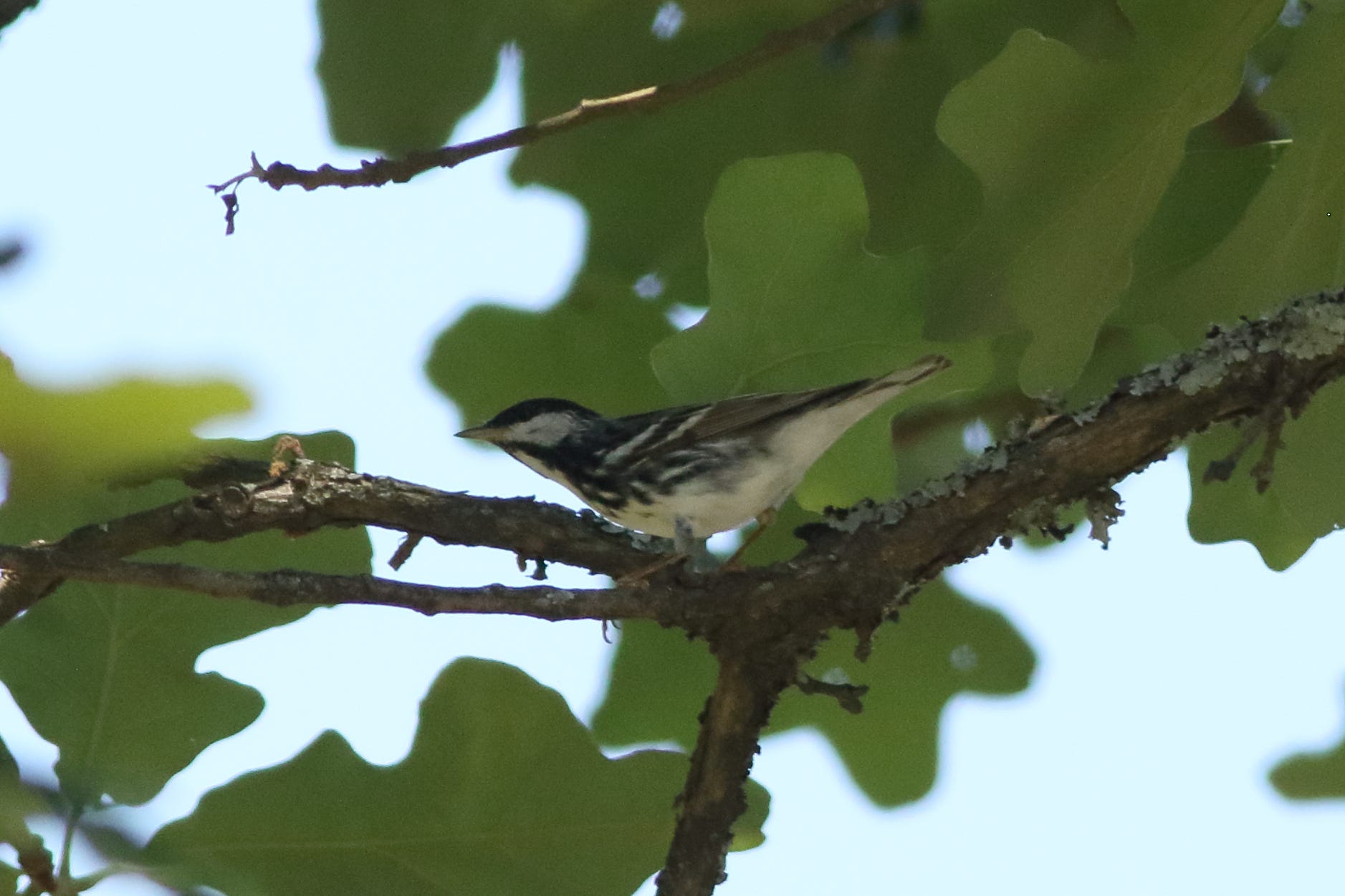
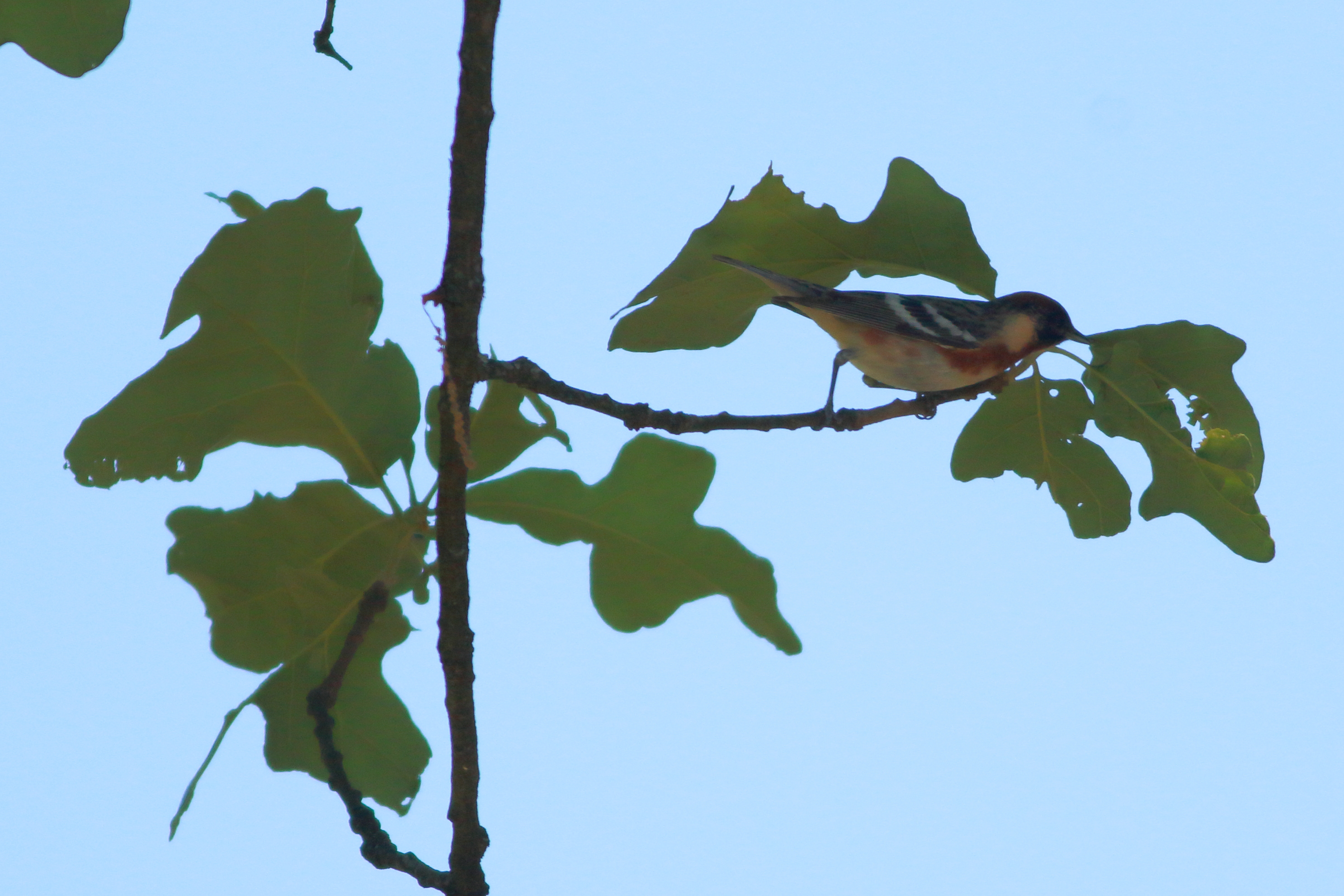
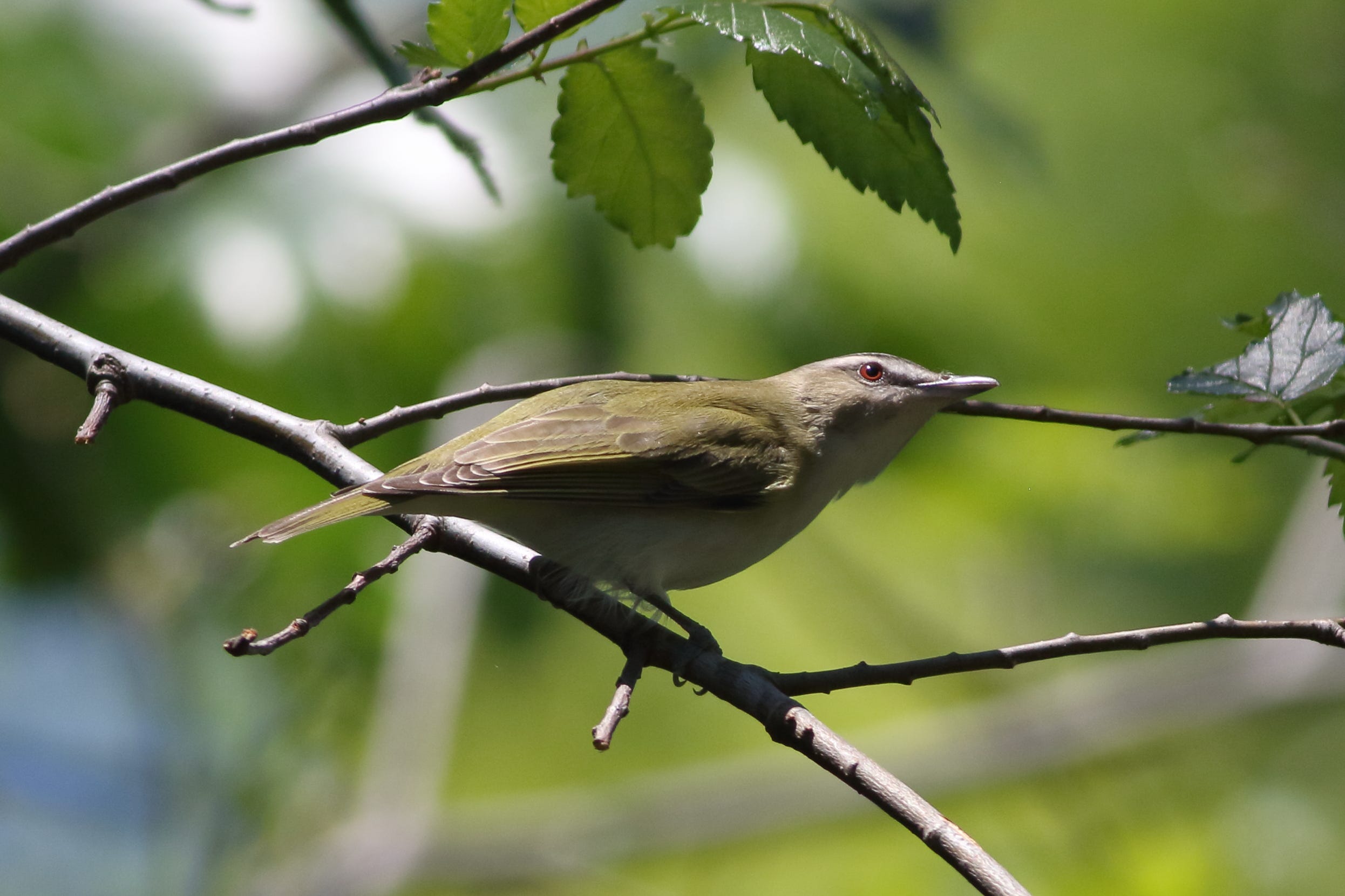
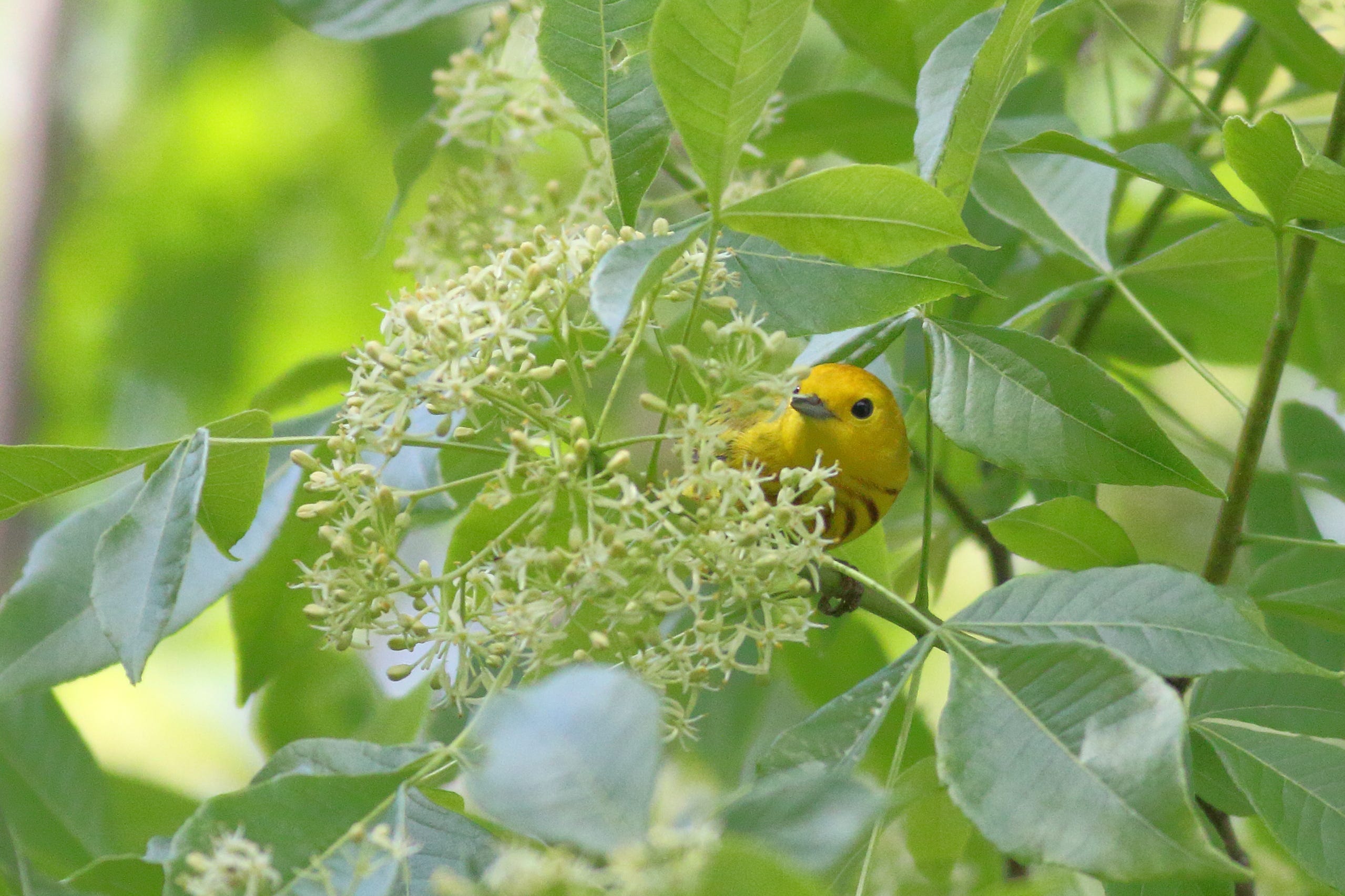
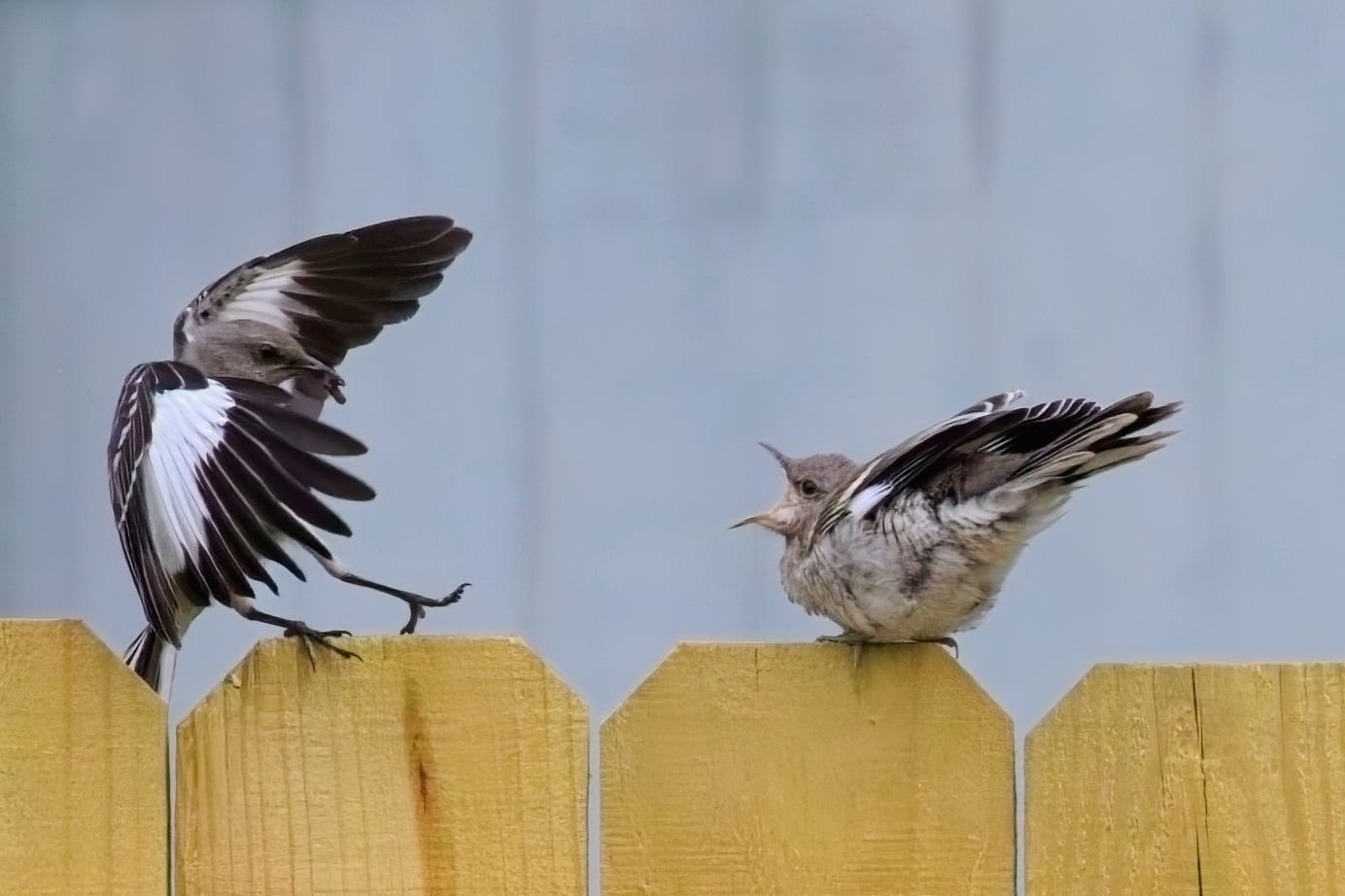
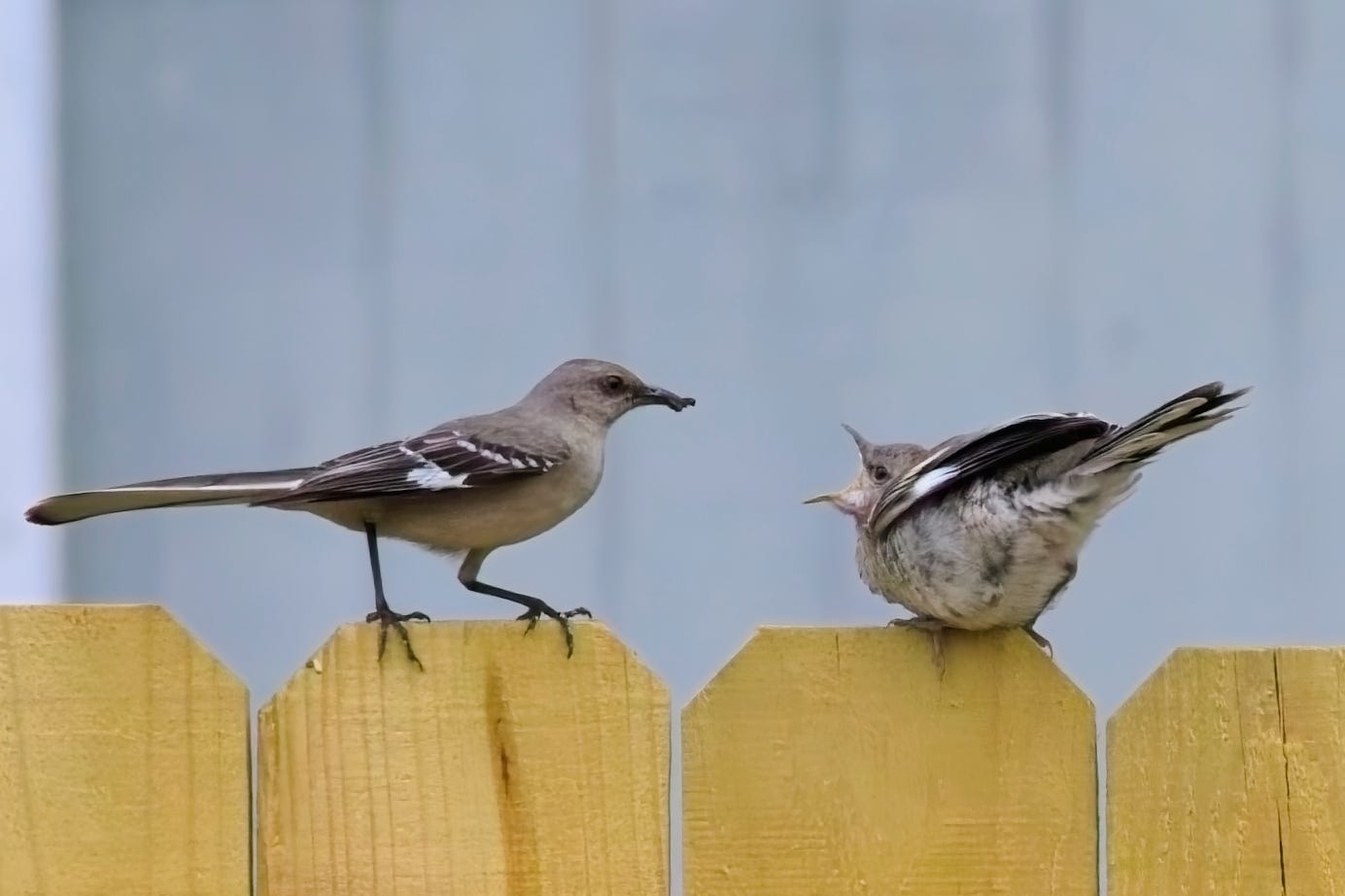
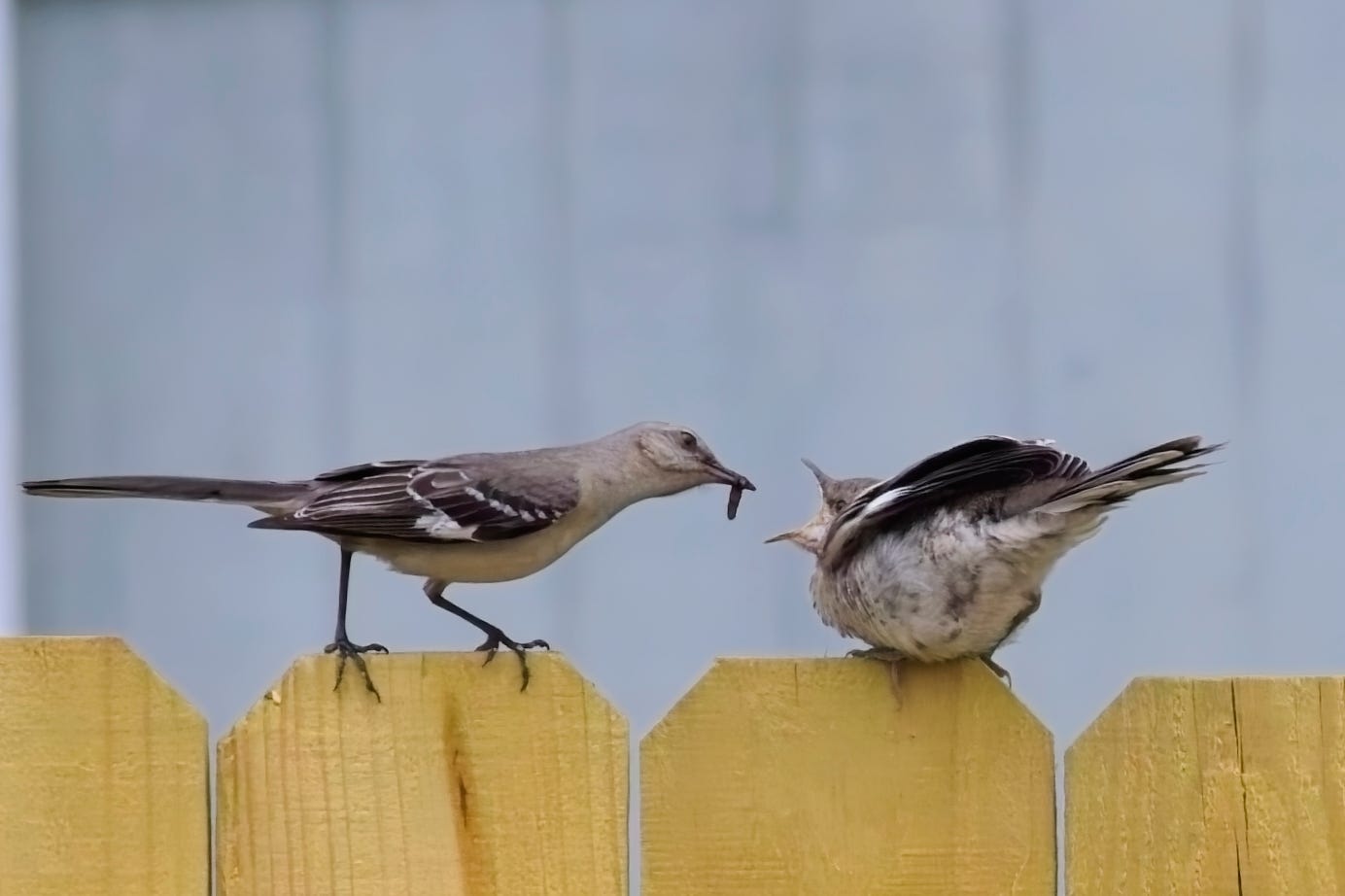
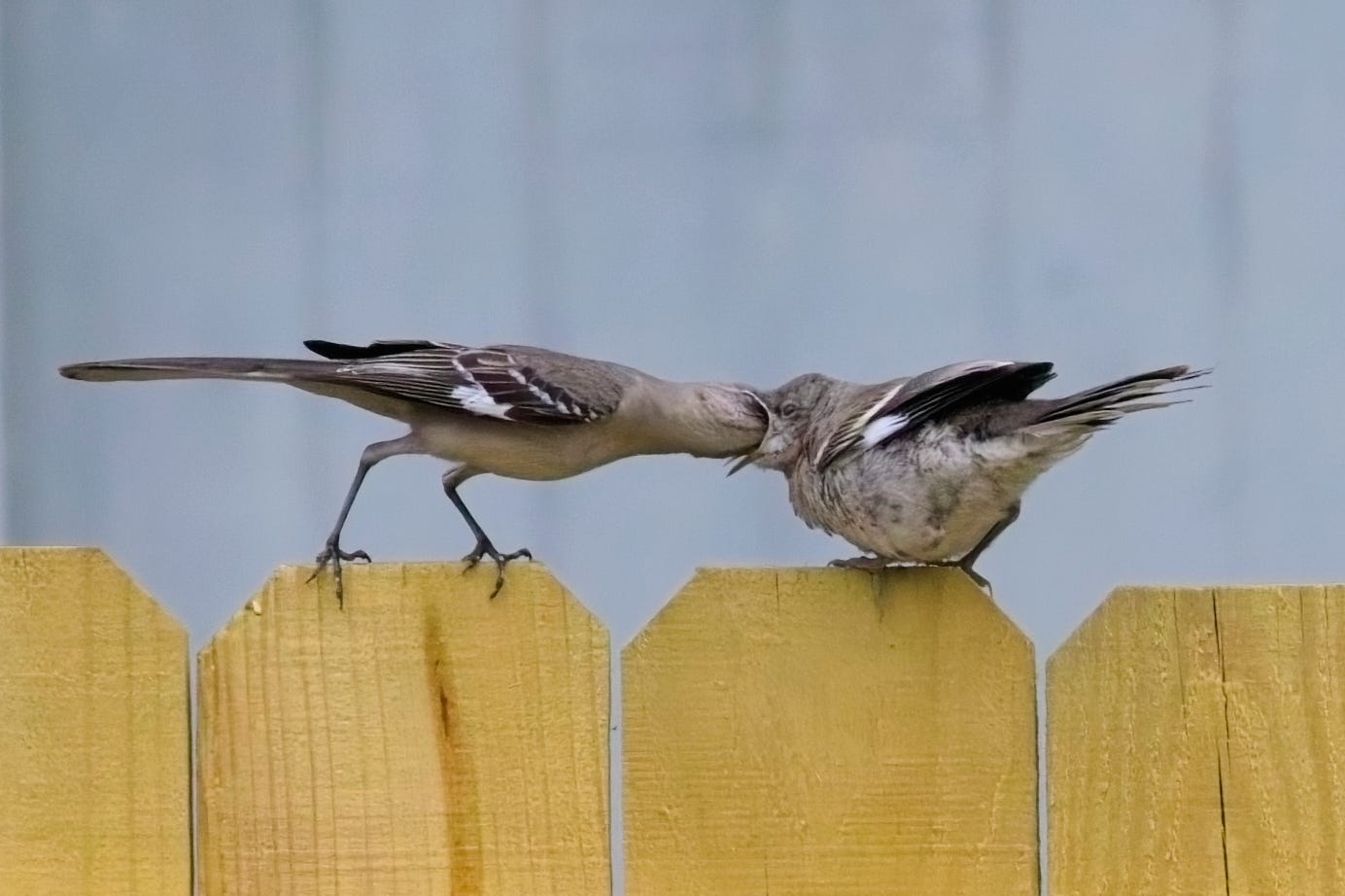
I conclude with a series some readers may have seen in Notes — a fledgling Northern mockingbird and parent, the parent landing on our neighbor’s backyard fence with a caterpillar (or something like it), then feeding the caterpillar (or whatever it is) to the baby, who waits with feathers fluffed and mouth open.
What backyard visitors have you been enjoying this spring?
What May adventures do you have planned?
Thank you for reading! All subscriptions are appreciated, and all content is available to all subscribers. If you would like to support my writing and photography financially, you may upgrade to a paid subscription, but it is not expected.
If you enjoyed this post and would like to give a small, one-time contribution, you may “buy me a coffee.” Digital downloads of print-ready photographs are (or will soon be) in the Buy Me a Coffee shop.
Prints are available at my Darkroom shop.
You can also support Falling in a Bog for free by clicking the heart button at the end (supposedly it helps the algorithm) or sharing this post with a friend!
Upcoming Events and Community Science
Georgia Botanical Society has several free field trips coming up in May! These include a paddle on the Flint River to see the rare Shoals spider lilies, a trip to a mountain bog where the endangered green pitcher plant (aka “fly bugle”) grows, followed by a trip to Brasstown Seeps, where unusual mountain flora mingle with unusual flora typically associated with the Coastal Plain (or at least, I associate the orchids in particular with the Coastal Plain.)
Dragonfly Week runs from July 4th through 12th. The British Dragonfly Society has recognized this week for years, and I think we should celebrate here in the U.S., too!
World Snake Day is July 16th. (I cannot find an official webpage for it yet.)
National Moth Week is July 18th-26th!
If you know of any community science days or weeks or events in May and June, please let me know!
Find community science events at the SciStarter calendar. To suggest an event or initiative for me to include in future posts — wherever you are, not limited to the Southeastern US — reply to this post in your inbox, send me a Substack message, or


I also have a backyard first this spring, which happens to be a blackpoll warbler!
We’ve only been in central VA two years & are in a development that also has some wooded areas. I’ve been so excited to have Blue-gray Gnatcatchers in & near our yard. A few weeks ago a pair were investigating the elderberry plants we put in. Squee!
A great crested flycatcher vocally showed up briefly in a Merlin recording this morning as well as a Swainton’s Thrush, but I couldn’t lay binocular eyes on either.